
D&D
How to Run a Boss Fight in D&D: Tips for Epic Encounters
MAR 26, 2026

The heart of any compelling Dungeons & Dragons campaign beats strongest in its most climactic encounters. Above all else, your players will remember the epic confrontation that defined a villain and tested their mettle. Good boss fights are more than just large-scale brawlfests, but the culmination of everything the DM has prepared and the payoff for everything the players have invested in. The boss fight is the pinnacle of most RPGs, and for many DMs seeking to master both game design and worldbuilding skills, the single most important encounter of any narrative. Fail to pull off a challenging yet rewarding boss fight, and things will feel unresolved and, worse, boring (aka the DM's worst enemy). For such a pivotal scene, it’s important to make sure you’ve designed an encounter that will not only be fun and narratively engaging, but most importantly, memorable.
The Three Pillars of D&D 5.5e Boss Design
If you’re not sure where to start with designing your climactic boss fight encounter, look no further than the boss themselves. Sometimes called the BBEG (Big Bad Evil Guy/Gal), the boss is not only the centerpiece of the encounter, but for most adventures, the story itself. Taking the time to review your boss and make the tweaks that will not only make the encounter more engaging, but bring the character to life to reflect the evolving and ever-changing narrative, will set your boss fights apart from the standard health sponge battle.
Challenge Ratings
In some ways, Challenge Ratings (CR) are an excellent metaphor for the rules of D&D as a whole. The Challenge Rating system is incredibly handy, and in most cases, a foolproof tool for keeping encounters balanced. However, like anything in D&D, it’s best considered a benchmark to provide guidelines should you choose to go “off-book”. The CR system is built to help build balanced encounters, but with that information, DMs are then equipped with the tools to build imbalanced encounters, and in essence, a good boss fight should feel a little imbalanced. In D&D 5.5e, the fundamental mechanics of CR apply to a wide set of encounters, but to apply the system to a singular, powerful antagonist requires some nuance. Think of it this way: a singular creature with a CR equal to the party’s average level might be a breeze for a party at full strength. On the other hand, a couple well placed creatures of a slightly lower CR can finish off a party retreating from a devastating encounter, having expended all their resources.
DMs should consider the party's likely state – are they fresh, or have they endured multiple encounters, skirmishes, and perhaps even faced minor threats that depleted their spell slots and Hit Points? Don’t feel afraid to turn up the heat. A boss encounter should push the party, but not feel insurmountable due to unpreparedness or an overreliance on the CR number alone. If you’re running an encounter that pits the party against the boss in a one-on-one encounter, bumping up the CR level by a couple of points is not a bad idea. You’ll be surprised by how many of your players have been eagerly awaiting this exact encounter to reveal various tricks they’ve had up their sleeve.
Action Economy
The scariest part of a truly devastating boss is how many attacks they can make. Just when you think it’s over, the BBEG gets a bonus action, and the damage die just keeps on rolling. Most boss monsters are designed to manipulate the action economy, capitalizing on actions per round to devastating effect. Legendary actions, legendary resistances, and lair actions are your archvillain’s main tools to exert control in combat.
Legendary Actions
Legendary actions allow monsters to act outside of their turn, granting anything from extra movements to extra attacks or special abilities. This is where the fear should really begin to set in for your players, as they realize they’re up against a creature that does not adhere to the conventional “rules” of turn order.
Legendary Resistances
Powerful creatures like dragons often have legendary resistances, allowing them to automatically succeed on saving throws a limited number of times per day. Legendary resistances prevent a single failed save from cutting your boss fight short, so the epic villain encounter you’ve been working on can remain a credible threat.
Lair Actions
Some legendary creatures have lair actions, which enable them to trigger ambient magic effects when within their lair. On initiative count 20, monsters within their lair can use their lair actions for game-changing effects that play to their advantage, such as: Magma Geysers, Summoned Spirits or Warped Terrain.
Unique Stat Blocks and Abilities
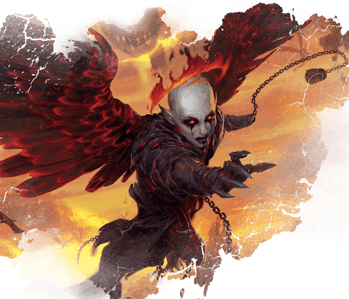
A boss battle will be most memorable when it is shaped in part by the impact that the players had on the world. While the Monster Manual offers a plethora of creatures suitable as bosses for most adventures, the key to standing out amongst the rest in your players' hearts is to customize. Beyond just being unique, your antagonist should reflect their place in the larger story. For a more comedic setting, your red dragon boss fight might flavor its fire breath as a hacking cough and its scorching ray as devastating sneezes, or a darker setting might flavor the Blob of Annihilation as a shrieking blob of human victims, perhaps even recognized allies among them.
Think about how the boss uses its environment, its minions, and its signature moves to create memorable moments. A boss might have an ability that specifically targets a player’s greatest strength or exploits a known weakness of the party composition. The goal should be to transform a generic monster into an unforgettable villain that directly affects the players at your table.
Using Narratives & Character Psychology
Beyond raw combat statistics and unique abilities, the most effective boss encounters manipulate the players' minds and deplete their most valuable resource: confidence. Make no mistake, for all intents and purposes, the boss fight should be the most difficult fight of your adventure. Raising the stakes so that players feel the heat on both the combat and narrative levels not only creates tension but also makes the victory feel truly earned.
Secondary Objectives
Not every boss encounter needs to be a straightforward slugfest to zero Hit Points. In fact, it's more than likely that most parties take on boss fights with a super objective beyond just “beat the bad guy” already in mind. Whether it's getting their hands on an artifact, rescuing captured allies, or escaping a collapsing dungeon, secondary objectives are the real bread and butter of any good boss fight. Take a look at your story and consider what threat your BBEG truly represents, treating them more as a guardian of a crucial objective than as a mad, unchecked villain. A boss fight that presents more than just a target but also a unique tactical challenge, in which the party must achieve a goal while fending off a powerful threat, will create nuanced narrative outcomes beyond win or lose.
Building Tension and Impact
By the time your players reach the final fight, they should be coming up against the culmination of the narrative they’ve invested in throughout the adventure. While it’s certainly important to give your players a good fight, this is also where many of the loose ends and storylines are likely to come together, meaning building tension before the encounter even begins is crucial.
Foreshadowing is the key to making a boss fight feel epic beyond proportion. On some level, your players should know a boss battle is coming. Whether it’s because they’ve been unraveling clues that lead them to their villainous lair, or because an unearthly chill fills the air, alerting them to its presence. The more you set the stage for your boss fight, the more their eventual debut will feel truly impactful.
Foreshadowing bosses can be done in a number of ways, using various mediums to create a true sense of tension. Here are a couple ideas!
Music cues: Got a soundtrack playing in the Jukebox? Load up a haunting jingle or a weeping cello song and have it serve as a “theme” for the boss, playing whenever the villain is mentioned or referenced. Players will quickly learn to fear the cue, and will jump out of their seats at the very first note.
Clues: Drop repeated clues that foreshadow the villain throughout the party’s journey. Whether it’s a mysterious sigil that repeatedly appears, or a calling card left with every victim. No matter what you choose, here’s a pro tip: be heavy handed with your clues. Repeat them multiple times, and make sure your players note them down. The longer your adventure is, the more details like these will be forgotten over time.
Traitor: A truly disturbing way to foreshadow a villain, is to put them directly into the party. A harmless figure that secretly sabotages the players along the way, allowing them to slowly put it together and revealing themselves just before it’s too late. One of my favorite villains was a townswoman from a town the heroes “saved” from the BBEG of the previous adventure. As their story went on, the townswoman followed them around, posing as their biggest fan, only to later reveal that she had been sabotaging them along the way as a final act of revenge for their poor performance in her hometown.
Environmental Effects: Some villains are so powerful that the sun and moon will even bend to their will. A great example of foreshadowing villains using the environment can be found in The Witcher 3, when the Wild Hunt approaches and the air is suddenly filled with a chill.. It’s a small but subtle detail, and yet, when the sky darkens and Geralt can suddenly see his breath, he knows the Wild Hunt is nearby. Recreate a similar effect in your campaign, detailing decaying flora in the area or storm clouds on the horizon as your villain closes in on the players.
Master Your Table, Master the Battle
The tension doesn’t go out the window after the reveal. As the combat encounter goes on, the players need to feel the impact of their adventure on the boss fight itself. During the fight, use descriptive language to convey the boss’s ferocity, intelligence and personal vendetta against the heroes. Roleplay the boss’s reactions to not only the player’s actions but the character’s themselves. If they are unnerved by a powerful spell that the heroes had hidden up their sleeve, depict them faltering with the slightest glint of fear in their eye, before rallying. If the heroes lost an ally along the way, have your monstrous lich summon undead minions with the familiar face of their friend. Introduce unexpected twists that vary the tempo of combat, allowing moments of despair and hope to ebb and flow. These personal moments are the secret to making a generic fantasy villain feel like a unique and creative threat to your party.