
D&D
Conditions in D&D
JAN 15, 2026

Anyone who has found themselves in the midst of the battlefield in Dungeons & Dragons knows that truly anything can happen, from the impressive and epic to the outright outrageous and absurd. One minute you might be charging headfirst at a giant Basilisk, and the next you're encased head-to-toe in stone. Or one moment you’re chasing a pesky Quasit, just for it to turn invisible before you catch it. These are called conditions, and they’re the spice of the average D&D encounter. Even outside of combat, conditions like Charmed and Frightened can drastically alter play, turning social encounters into complex encounters defined just as much by their limitations as their possibilities.
Even as early as level 1, the reality of conditions is one you’ll be forced to reckon with. While some GMs might be less combat-focused, and others might be less RP-focused, encounters of all kinds are built upon the core loop of imposing and ignoring conditions. It’s a hallmark of a living, breathing world. Actions beget consequences and, in turn, open the door to a wealth of new possibilities and opportunities for further action. A Wizard who casts Grease creates the opportunity to impose the Prone condition upon those caught within, or a Brawler in a bar fight, wrestling for the last drop of mead, imposes the Grappled condition upon his drinking mates. Conditions are all around us!
There are a total of 14 conditions (15 including Exhaustion), and while most of them don’t stack, you can hold multiple conditions at once. A lot to keep track of during the heat of the moment! You can always refer to the DMG for an extensive breakdown of each condition for a little more insight on mechanics and in-game implications. Still, for most players, you’ll do best just by being aware of the different condition types and how they can affect your gameplay. Thankfully, we’ve got just the thing for the occasion.
Condition Types and In-Game Applications
|
Tactical Impact |
conditions |
In-Game Application |
|
Action Denial |
Stunned, Paralyzed, Unconscious, Incapacitated, Petrified |
These conditions can end fights outright by preventing creatures from acting or defending themselves |
|
Accuracy & Awareness |
Blinded, Poisoned, Invisible |
These conditions limit line of sight, impair accuracy, and obscure combatants |
|
Movement Control |
Grappled, Restrained, Prone |
These conditions decide who controls space, and who stays on the battlefield |
|
Mental Control |
Charmed, Frightened |
These conditions alter the mind, shaping tactics and impulses to create opportunity for advantage |
|
Long-Term Attrition |
Exhaustion |
This condition stacks over time to impair D20 tests and overall ability |
Group A: Action Denial
These are the conditions you’ll be glad you have in the heat of battle. When you find yourself in the path of a charging minotaur or caught within the clutches of a Tarrasque’s maw, you’ll want spells or attacks that will put an end to things as quickly as possible. conditions like Stunned will always come in handy in combat, as they grant advantage on attack rolls made against that target. Or Paralyzed, which reduces speed to 0 and turns any attack made against you within 5ft into a critical hit.
This is the “Action Denial” category, meaning each of the included conditions are defined by their ability to put an immediate stop to the targets actions. What unites these conditions under the umbrella of action-denying is one shared factor; a condition in and of itself - Incapacitated. If there’s any question about what specifically makes the Incapacitated Condition “action denying” take a look at it’s description.

Every condition within this group, also includes the effects of the Incapacitated condition. In other words, a player or NPC can become Incapacitated one of two ways; by having the Incapacitated condition imposed upon them, or by taking on the effects of the Stunned, Paralayzed, Unconscious or Petrified conditions, each of which include the Incapacitated condition on their own.
Some conditions come bundled with multiple effects belonging to other conditions for even greater effect. For example:

In a world of monsters and magic, it can be hard to keep things grounded on the battlefield. Especially when you’re up against ancient dragons and powerful lich-kings. Thankfully, nothing levels the playing field quite like getting stone-cold KO’d.
Group B: Accuracy & Awareness
The ideal conditions to have at your disposal for the strategist. These conditions can turn the tables in your favor by obscuring line of sight on the fly, allowing you or your teammates to disappear, or to impair your opponents aim.
At first glance, these three conditions might seem entirely disconnected from each other. Being Blinded is an entirely different experience than suffering from the effects of Poison, but what connects these conditions goes a bit deeper than what is seen on the surface. Much like the conditions mentioned earlier, the conditions within this category are united by a shared effect; Attacks Affected.
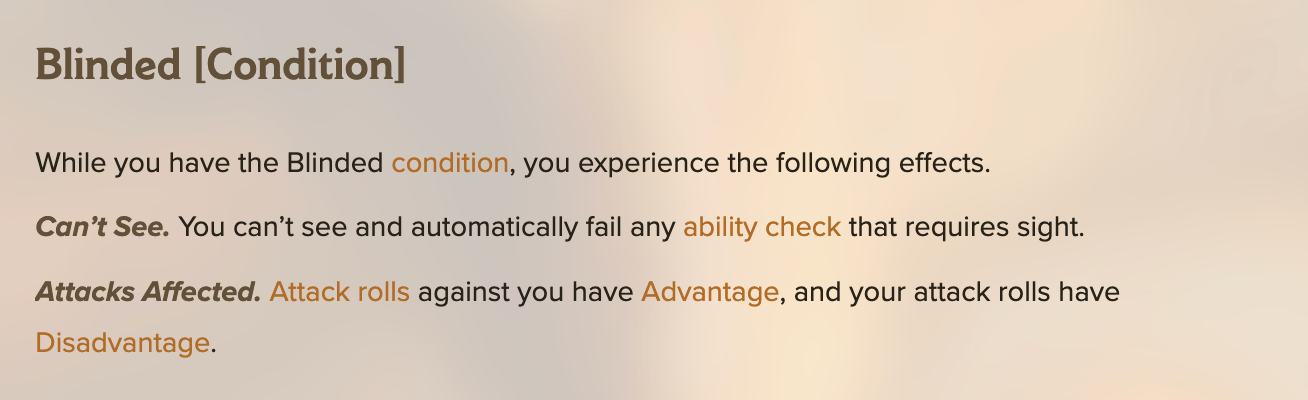
To simulate the effects of your impaired vision, the Blinded condition comes with an affect that makes you or your opponent easier to hit but conversely, worse at landing attacks. This affect exists in some form within all three of these conditions.

For the most part, being Invisible is only going to help you land your attacks, so while the Invisible Condition also comes with the Attacks Affected effect, you’ll notice this time it plays more in your favor. To counter the benefits of the Invisible condition, Poisoned offers the opposite affect.

With the Poisoned conditon, not only are your attacks severly impaired, you’ll take disadvantage on all ability checks as well. With the effects of these conditions combined, accuracy and awareness is drastically impaired, making the simple act of landing your blows suddenly much more of a challenge.
Group C: Movement Control
These are the conditions that define who has the upperhand at any given moment, thanks in large part to their affect on movement speed. While these aren’t necessarily built to put an immediate stop to action or limit line of sight, these conditions can rewrite the dynamic of the battlefield with sheer strength and dominance. This group features conditions like Grappled and Restrained, which are integral to the core gameplay loop of martial classes like Barbarians and Fighters and favored by those who pickup feats like Grappler. For some classes, this group of conditions will be your bread and butter.
In-game terms, these conditions are united by their direct affect on movement speed. Both Grappled and Restrained come with the Speed 0 affect, which fittingly, sets the condition holders speed to 0.

Restrained is similar to Grappled, but without the Movable effect. Instead, Restrained imposes disadvantage on Dexterity saving throws.

Prone is the biggest departure from the other two conditions in this category. Where Grappled and Restrained involve more active participation between two combatants, Prone is simply the condition meant to indicate that the condition holder is brought to their knees, or otherwise rendered vulnerable. Fortunately, being rendered Prone does not mean your outright unable to move. Instead you’re relegated to a crawl, depicted by the Restricted Movement effect.

Unlike the other conditions in this group, Prone grants attack rolls against the condition holder with advantage, making it a highly compromising condition to take on.
Group D: Mental Control
These conditions are the tools of the manipulator, best used both in and out of combat. Favored by spellcasters, the conditions within the Mental Control group are designed to reshape dynamics on the fly be rewriting psychology and personality instantaneously. Both of these conditions are defined by their affect on perception, so things don’t appear as exactly as they seem.

The Charmed condition provides tons of utility both in and out of combat, and compared to the others, is easily the best condition for social encounters. With the Social Advantage effect, those under the Charmed condition will find themselves much more impressionable and beguiled by the charmer. With how often the average D&D adventure involves social encounters that require wit and charisma, having a little help from the Charmed condition can go a long way.
Thanks to the Can’t Harm the Charmer effect, the Charmed condition can additionally provide tons of utility in-combat. Those under the Charmed condition are unable to attack or target the charmer, essentially removing a threat from the battlefield.

While the Frightened Condition doesn’t outright detail a social effect like Charmed does, it isn’t unreasonable to assume that it would provide some advantage in social encounters. Those suffering from the Frightened Condition, are effectively afraid of the caster, which explains the Can’t Approach affect. Similar to Charmed, the Frightened Condition includes affects that protect the caster from being the primary focus of combat.
Exhaustion
As the only stackable condition in D&D, Exhaustion is deserving of an entire category on its own. In other words, while you can take on multiple conditions at once (ie: Blinded while Poisoned and Prone) you are not able to take multiple levels of Prone. Once you’re out of the encounter, the round has ended, or the context has otherwise changed, you’ll lose your condition. Exhaustion is a completely different story. The only way to remove the Exhaustion condition is by taking a long rest, providing you have few enough levels of Exhaustion that one nights rest will do the job. You’ll want to make sure you clear your Exhaustion levels as soon as possible, because the toll it takes is all-encompasing, essentially giving you disadvantage on any possible roll you can make.

Exhaustion can be imposed in a number of ways. Some spells and features are described as incurring or causing Exhaustion, like the Barbarian’s Rage, or the Sickening Radiance spell, but Exhaustion is a mechanic best used at the DM’s discretion, as a tool to underline the rules and consequences of your chosen setting. A natural fit for survival campaigns, a DM could choose to impose Exhaustion on their players due to starvation and dehydration, travelling at-length, extreme weather, and of course, lack of rest.
With a clearer grasp of how each condition works, you’re better equipped to make sharper decisions in and out of combat. Bring this knowledge to the table, experiment with new tactics, and pay attention to how small status changes can swing an entire encounter. The best way to master conditions is to use them, so try a few bold plays in your next session and see what happens.