
D&D
How to Start Playing D&D in 2026
JAN 15, 2026

Dungeons & Dragons has been a cornerstone of TTRPG gaming for over fifty years, but for the uninitiated, stepping into a world of swords, sorcery, and shared stories can feel like an epic quest in and of itself. For some, playing D&D might feel like second nature, but at one point, all of us were new to everyone's favorite TTRPG. Thankfully, for those looking to begin their adventure in 2026, the game of Dungeons and Dragons is more accessible than ever before. With 5.5e as the latest addition to the ruleset, the traditional experience is becoming more refined and streamlined to appeal to the global community and support fantasy fans of all types. Whether that means gathering around the table with family or using digital tools to game with your friends abroad, the D&D experience is fast becoming a go-to for those looking to pick up a hobby built around community. If D&D has piqued your interest, whether you aim to defeat villains and reach new levels or just to tell silly stories with your friends, your journey starts here.
The Fundamentals
Before we dive right into your first game of D&D, let's make sure we're on the same page about what D&D actually is. You might be familiar with the concept of an RPG, and perhaps even familiar with the idea of the Tabletop Role Playing Game (TTRPG), but if not, let's cover the basics.
RPG = Role Playing Game
A role-playing game is a narrative game in which the player takes on the role of a character, engaging with and affecting a fictional world. Typically, RPGs are video games in which things like combat and specific mechanics are handled in the background by the game engine. Examples include: Elden Ring, The Elder Scrolls, Fallout, The Witcher, Cyberpunk, and Baldur's Gate 3.
TTRPG = Tabletop Role Playing Game
In a tabletop role-playing game, the player takes on the role of a character in a manner closer to a performance, embodying that character's perspectives and personality. Tabletop role-playing games differentiate themselves as an experience designed to be played as a board game or across a "tabletop" rather than with a computer or console. Unlike video games, tabletop role-playing games rely on a game master to handle the computations and mechanics that would otherwise be "behind the scenes" in a video game. Combat and social encounters are resolved before your very eyes with a combination of dice rolls, each of which represents the various abilities and skill levels of characters within the world. Examples include Dungeons & Dragons, Daggerheart, Pathfinder, and Call of Cthulhu.
How Many People Do You Need to Start Playing?
D&D can be played with any number of people from 1 to 100. No one would recommend playing with 100 people, mainly because your DM is likely to spontaneously combust, but never say never.
While we're on the topic, let's talk a bit more about the DM
The Dungeon Master
Put simply, one person, the Dungeon Master or DM (sometimes referred to as the Game Master or GM), creates a world and a scenario, while the other players create characters to explore that world. "Creating a world" might sound a little daunting, but thankfully, this is where Adventure and Campaign Modules come in. Since the very first days of D&D, Wizards of the Coast has released tons of supplemental materials to aid DMs with complete settings and adventures. Iconic adventures like Curse of Strahd, Tomb of Annihilation, or Waterdeep: Dragon Heist are favorites of DMs, both novice and veteran. If you or your DM will be DMing for the first time, it's definitely suggested to flip through one of these iconic D&D adventures just to get a sense of the type of storytelling expected of the Dungeon Master.
Find or Build a Group Using Roll20’s tools
D&D is a social game, and finding the right group is crucial. In 2026, your options are plentiful.
- LFG on Roll20: Roll20’s built‑in LFG listings are a common starting point; advice threads for new players often point people there when they have no local group.
- Friends and Family: This is the ideal starting point. Teaching the game to people you already know and trust is often the most comfortable way to learn.
- Local Game Stores: Most game stores host D&D nights, including beginner-friendly sessions. They are hubs for the community and a great place to meet local players and DMs.
When looking for a group, be clear about your experience level and what kind of game you want to play (e.g., combat-heavy, roleplay-focused, a mix of both). But most importantly, be a collaborator! Help your fellow players enjoy the game by engaging with the world and your party in-character.
Which D&D Starter Set is Best and What Are the Differences?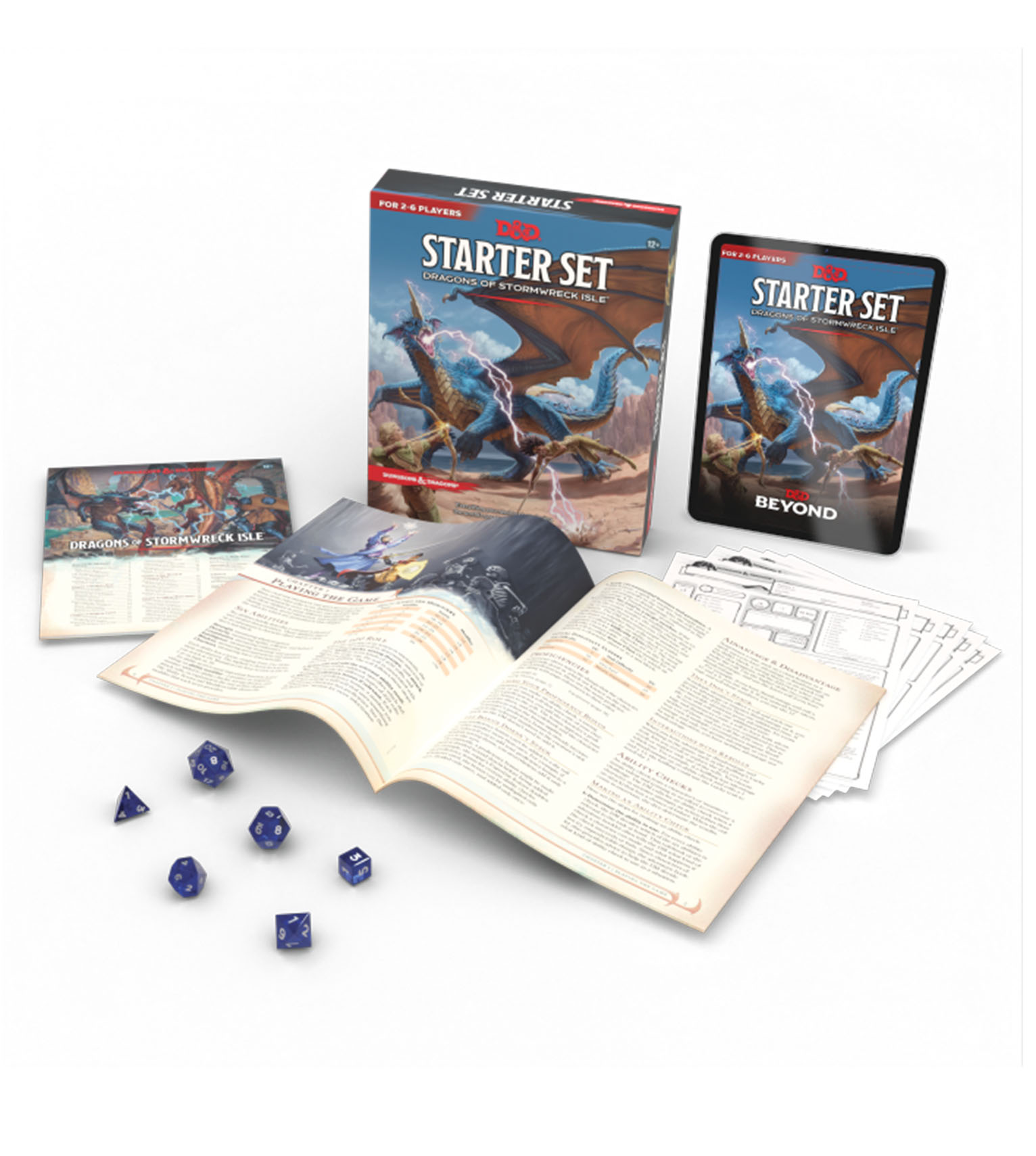
For most new players, a Starter Set is the single best entry point into Dungeons & Dragons. Starter Sets are all-in-one box sets designed to be opened and played with minimal prior knowledge. Meaning once you're done running a Starter Set adventure, you should be up to speed on the fundamentals of D&D.
As of 2026, there are a few primary options to consider, each catering to slightly different tastes.
Dragons of Stormwreck Isle
In many ways, Dragons of Stormwreck Isle is the quintessential D&D Starter Set. Released in 2022, Dragons of Stormwreck Isle has remained the gold standard for first-timers. Including a streamlined 32-page rulebook covering everything pertinent to levels 1-3, Dragons of Stormwreck Isle doesn't overstay its welcome. Without inundating the reader with D&D's most intricate systems, Dragons of Stormwreck Isle manages to get players up and running with all the tools they need to experience a complete adventure as quickly as possible. Where starting from scratch can introduce some pain points for new players, Dragons of Stormwreck Isle cleverly circumvents those issues with tons of pre-generated content, including five character sheets each representing different classes and play styles.
The adventure itself is masterfully designed to teach the game's core mechanics, whether it's exploration, social interaction, or combat. Dragons of Stormwreck Isle is perhaps the ideal choice for groups where everyone, including the DM, is brand new.
D&D Essentials Kit
Another excellent option is the D&D Essentials Kit. While this starter set is just as approachable for entirely new players, the Essentials Kit might be the natural choice for players who are a little more familiar with the traditional conventions of the RPG format, where Dragons of Stormwreck Isle offers five pre-generated character sheets, the D&D Essentials Kit takes things a step further by including rules for creating your own characters, allowing players to connect with their characters more personally.
The adventure within the D&D Essentials Kit, Dragon of Icespire Peak, is more open-ended than Stormwreck Isle, offering a sandbox-style experience where players can choose which quests to pursue. It also uniquely includes rules for one-on-one play, perfect for a duo where one person is the DM and the other is the player.
The latest addition to the Dungeons & Dragons line of starter sets, Heroes of the Borderlands is probably the best place to start for players looking to get acquainted with the latest mechanics and changes in D&D. While earlier starter sets will serve just as well for beginners, Heroes of the Borderlands is without any doubt, the best way to get newcomers up to date with D&D’s latest developments as of 2024’s 5.5e ruleset. Even better, Heroes of the Borderlands is a great way to give players a sense of the history of D&D releases, as the starter set revamps three older adventures for the modern era. Inspired by “Keep on the Borderlands” written by the father of D&D, Gary Gygax himself, Heroes of the Borderlands contains three adventures, each designed to introduce players to new elements of D&D, and the TTRPG format as a whole. The Keep on the Borderlands is an adventure that introduces a fortified outpost and a social hub, teaching players both exploration and social interaction with npcs, The Wilderness teaches survival mechanics through random encounters and exploration, and The Caves of Chaos, introduces the classic dungeon crawl with monsters, treasure, and tactical challenges.
Which Is Right for Me?
When choosing, consider your group: for a guided, learn-as-you-go experience, Stormwreck Isle is perfect. For more creative freedom and a toolkit that supports you beyond the first few sessions, the Essentials Kit or a newer 2024-aligned set like Heroes of the Borderlands is the superior choice.
Do I need a Starter Set to Start Playing D&D in 2026?
No, a Starter Set is not mandatory. While highly recommended for their convenience and value, you can absolutely begin your D&D journey by gathering the essential components individually. Just make sure you know what you're getting into! The à la carte approach offers more flexibility but requires a bit more initiative to get started. Don't worry. If you have any pressing questions, you can always direct them to the Roll20 forum!
What Do I Actually Need to Get Started?
If you opt out of a Starter Set or just want to know what to get next, here are the fundamental building blocks of any D&D game.
1. Use Roll20’s character sheets and digitally-enhanced modules
- The Player Handbook does walk you through the specifics of creating a character with pen and paper, but for new players, the process can be somewhat disorienting as it often involves flipping back and forth and notating different stats until your character sheet is filled out completely. Thankfully, Roll20 offers an alternative with 5e character sheets that provide integrated roll buttons, advantage toggles, and auto‑calculated skills. Perfect for beginners more accustomed to digital tools.
- For beginners, it's highly recommended to pick up modules with full digital support as many marketplace modules come with pre‑built NPCs and monsters that roll initiative, attacks, and damage directly from the sheet, cutting down on rules overhead for new DMs. Looking for some examples? Try Lost Mine of Phandelver, Curse of Strahd, or Eberron: Rising from the Last War, just to name a few!
2. Roll20's VTT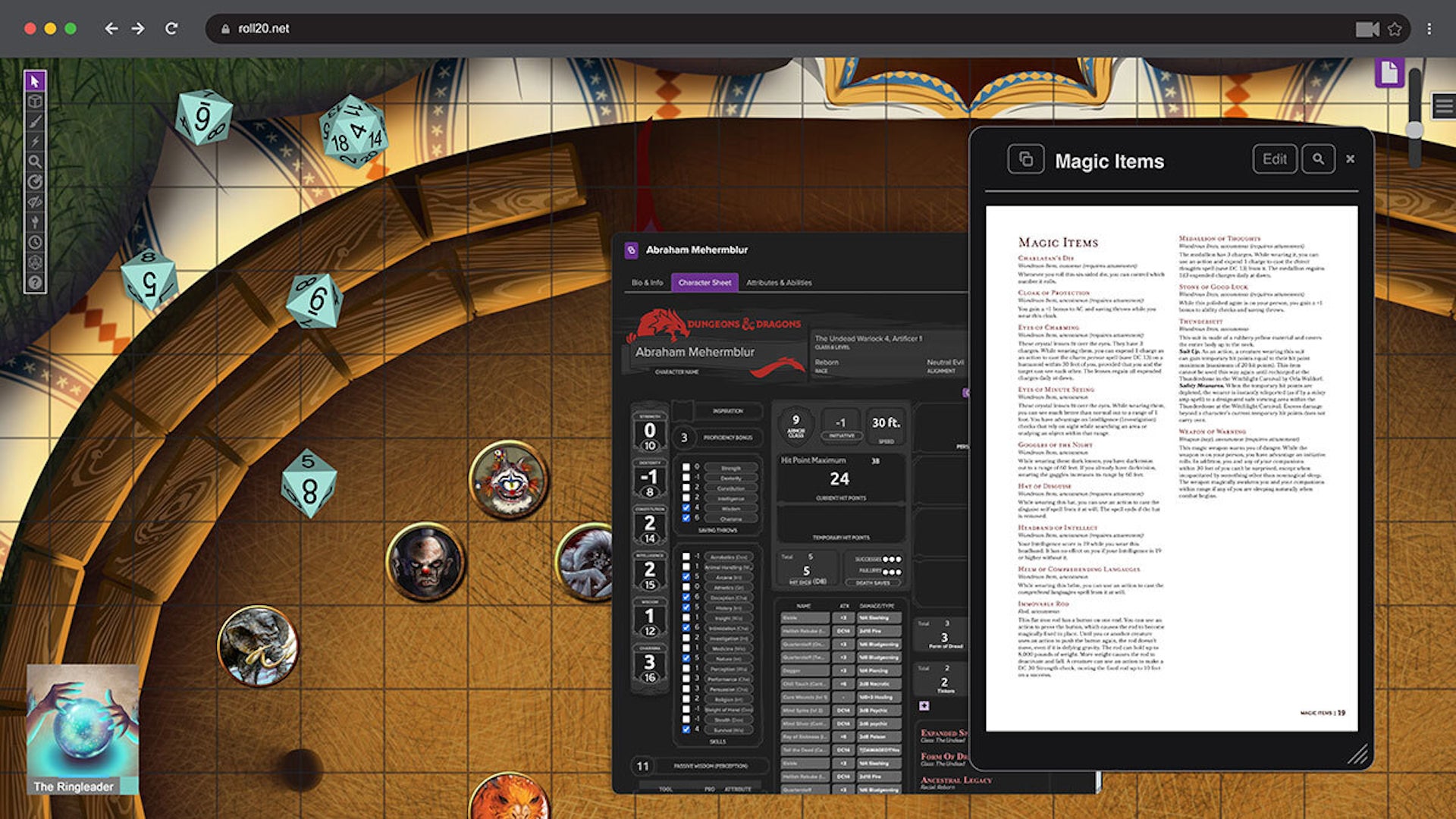
Roll20 is one of the most established and widely used Virtual Tabletops (VTTs), offering a free tier that is more than sufficient for starting a campaign. With the Roll20 VTT, a DM can share maps and control encounters while players move their tokens and manage their character sheets directly within the platform. Using a VTT is an excellent way to connect with players from around the world, making it much easier to find a group that fits your schedule and playstyle.
3. Core Books
The foundation of D&D is its three core rulebooks. For a player starting in 2026, the key is to look for the versions revised in 2024, which offer the most up-to-date rules and presentation.
- Player's Handbook (PHB): This is the single most important book for any player. It contains all the rules for creating characters, the mechanics of gameplay (skills, combat, spellcasting), and a comprehensive list of equipment and spells. If you are only going to buy one book, make it this one.
- Dungeon Master's Guide (DMG): As the name implies, this book is for the DM. It’s a toolkit filled with advice on building worlds, creating adventures, managing a game session, and handling unique rules situations. It also contains a vast catalog of magic items. New players don't necessarily need this book, but if you'd like to get a better sense of what exactly makes D&D tick, this is the book to pick up.
- Monster Manual (MM): This book is a bestiary, packed with hundreds of creatures for DMs to populate their worlds with. From lowly goblins to terrifying ancient dragons, the MM provides the statistics, lore, and abilities for the challenges players will face. Like the DMG, this is a resource primarily for the DM
Make 2026 Your Year of Dungeons & Dragons
2026 might be the best year yet for beginners looking to get into Dungeons & Dragons. In recent years, the design philosophy behind Dungeons & Dragons has evolved into one that is more welcoming to newcomers than ever, balancing a rich history with modern accessibility and game mechanic sensibilities. As rules-rich as D&D may seem, the truth is, Dungeons & Dragons is at a place where it's more possible than ever to start simple. You don't need every rulebook or accessory (hold off on that shiny dice tower!), because at its core, D&D is a game that requires a little imagination, some dice, and a couple of friends. Whether you decide to play as a heroic character or take the helm as a Dungeon Master, the ultimate goal is to build a memorable story together. Embrace the learning process, don't be afraid to make mistakes, and prepare to embark on an adventure defined by your collective imagination.