
D&D
Guide to Pets and Companions in D&D and Tabletop RPGs
APR 13, 2026

Until recently, pets and companions in D&D were notoriously undersupported, ending up more as liabilities that required too much stat management and bookkeeping for the average player.
The 2024 D&D 5.5e update aims to refresh this system, transforming companions from mascots and accessories into necessary tactical assets. Whether you're playing a Ranger who commands a beast in the heat of combat or a Wizard who sees through the eyes of their pet owl to scout dungeons, the updated rules give your pet companion a role to play in any scenario. But not unlike being a pet owner in real life, choosing your animal companion is a big decision, and one worth a little investigation. Still, it's never a bad choice to take on a feline friend, canine companion, or something else.
If you're looking to pick out a pet for your D&D next adventure, read on.
 What is the Difference Between Pets and Companions?
Before we go any further, let's take a moment to define the core difference between pets and companions. As of 2024, D&D's latest ruleset has no universal "pet" system for ordinary animals, meaning most non-magical pets are more like NPC sidekicks whose core function is to aid the roleplay and narrative of your adventure. Companions, on the other hand, are animal allies who offer battlefield support, utility, and active engagement with your character's abilities. Where pets are the better choice to accessorize your character and provide some flavor to roleplay scenarios without having to keep track of their stats, companions offer raw mechanical advantages, at the cost of managing what is essentially a second character. Taking on a companion is a big responsibility. Not only does it mean going for walks and playing fetch, but managing your companions' abilities, commanding them in combat, and doing your best to keep them alive.
What Pets Can Players Have in Dungeons & Dragons 5.5e?
As far as flavor goes, players can consider almost any feasibly domesticated creature as a possible pet. Some DM's may rule otherwise, but for the most part, any character of any background is capable of owning a pet dog, raccoon, or snake. However, make no mistake. This form of pet should be considered a mundane creature, with no extraordinary abilities. A basic bite or scratch attack, a feasible movement speed, and perhaps most importantly, a realistic health pool. In other words, pets are likely going to be the type of companion you'd realistically prefer to stay out of combat. While they may still provide some value (depending on your DM), for the occasional recon mission or distraction, regular pets will have regular limitations.
Conversely, animal companions are often magical or innately powerful creatures who are more than capable of handling themselves in combat. For spellcast
ers, animal companions can provide a wealth of utility thanks to the Find Familiar spell.
Finding Your Familiar

Through the Find Familiar spell, any spellcaster can gain a magically bound creature from a list of Challenge Rating 0 creatures, including:
- Cat
- Frog
- Octopus
- Hawk
Familiars are unlike mundane pets in that they can't really die. While they certainly aren't combat powerhouses, they can provide distinct advantages at key moments of battle, and if felled, can be re-summoned with another use of Find Familiar.
Non-spellcasters can enjoy their own animal companions, and even have their own unique relationships with their companions, unlike those of the spellcasters' familiars. In fact, if we're really going to examine the concept of "pets" in D&D, there's no better place to look than towards the Ranger.
What is the Best Class for Animal Companions?

The Beast Master Ranger
The Beast Master Ranger is perhaps the strongest official animal companion class in D&D. Unlike other classes, which treat the companion as a side feature of a larger kit, the Beast Master Ranger makes their relationship with animal companions central to the subclass identity.
The Beast Master Ranger's companion is not an individual beast selected from the Monster Manual, like in Find Familiar's case. Instead, the Beast Master Ranger's Primal Companion is a unified spirit that manifests as a Land, Sea, or Sky beast. It's up to the player's discretion what form that creature takes, and even what type of creature they choose to summon. Rather than playing the role of the pet combatant, the Primal Companion is meant to serve as a real battlefield presence, providing tactical advantages that fit with your character from level one to 20.
The Beast in Combat
The Beast Master Ranger uses their companion as an extension of their turn, commanding their pet to attack or perform actions alongside them on the battlefield. Where a Familiar might provide battlefield analysis or recon using its mental connection to the spellcaster, the Primal Companion provides value with raw damage output and battle effectiveness that scales with its Ranger master. With the Primal Companion's Primal Bond ability, any ability check or saving throw the animal makes receives a bonus equal to the Ranger's proficiency modifier, making them feared tactical combatants.
Each Primal Companion type has a unique specialty:
-
Beast of the Land: Excels at rendering enemies prone.
-
Beast of the Sky: Flying attacks that don't trigger opportunity attacks
-
Beast of the Sea: Able to breathe on land and underwater + grapple
Pets for Other Classes
Warlocks
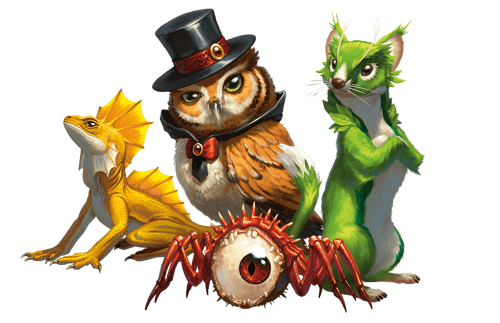
One thing is true about Warlocks: They'll never turn down the opportunity to be just a little... weird. A fact that holds true even when it comes to their companions. Warlocks who take the Pact of the Chain forge an arcane relationship with an unfamiliar creature of another realm, possessing unique traits such as invisibility or specialized magic resistance. Through the Pact of the Chain, Warlocks can summon:
- Imps
- Pseudodragons
- Quasits
- Skeletons
- Slaad Tadpoles
- & more
When paired with the Warlock's Eldritch Invocations, these familiars can attack or exert influence beyond the ability of the average animal companion, making them some of the most versatile pets available in D&D.
Paladins
The Paladin's steed is an often overlooked aspect of the Paladin class, but one that provides plenty of utility. Beyond providing mobility, the steed offers the Paladin the benefit of shared spell effects, allowing for defensive buffs that protect the rider and mount.
Steeds are not unlike the familiars of the Find Familiar spell, only in this case, they are summoned and resummoned with the Find Steed spell. The speed can take any appearance and form you like, and should be treated as a devoted and loyal companion.
How Non-Pet Classes Can Acquire Companions
Between Wizards, Warlocks, and Paladins, it might seem like the best option to choose for an animal companion is to play as a spellcaster, but in reality, there are a number of ways martial classes can gain the trust of an animal sidekick.
The Magic Initiate Feat
If you'd like your own familiar but don't want to make a major class investment, a non-spellcaster can take the Magic Initiate feat in order to pick up the Find Familiar spell. This provides a valid route to summoning your own familiar, but it comes at the cost of a feature investment.
Ritual Caster
Similar to the Magic Initiate feat, you can also grab Ritual Caster to summon familiars without expending a spell slot. However, make sure to choose Wizard for the feat spell list, since Find Familiar is a 1st-level wizard ritual spell.
Animal Handling Checks for Mundane Pets
When in doubt, there's always the old-fashioned way. For those who prefer the non-magical approach, mundane pets are still available, provided you succeed on an Animal Handling check. Much like in real life, a well-formed relationship with an animal means forming a connection with a lifelong friend. While they lack the magical "resurrection" of the Find Familiar spell, they provide immense depth for roleplay-focused campaigns.
Choosing the Right Companion for Your Adventure
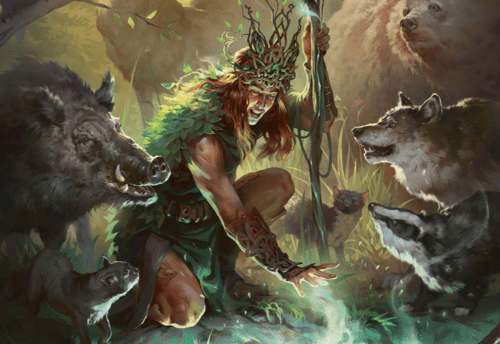
The world of pets and companions has matured and evolved in D&D 5.5e into a robust system full of not only roleplay opportunities but combat synergy that offers something for every playstyle. While the Beast Master Ranger is the undisputed champion for players who want a combat partner, Find Familiar, & Pact of the Chain provides a play experience based around an intellectual relationship with a creature of your choosing.
When choosing your companion, there's really no wrong way to go. Whether it's about finding a fluffy friend who will sit on your lap and provide a little personality, or forging a relationship with a battle-hardened sidekick who will defend you with their last breath, there are more than enough options to experiment with. If you're not sure where to begin, start by identifying your primary need: is it a front-line fighter, a scout to provide recon behind enemy lines, or a thematic companion to help assist in roleplay? Regardless of where you land, treat your pet as an extension of your character. An actively evolving reflection of your character's growth. With 5.5e's new scaling rules for companions, it's very likely your chosen pet will fight by your side from the very first tavern meetup to the final battle at the edge of the world. Fiercely loyal, forever caring, and most importantly, your best friend, even in Toril, animals are the best of us.