
D&D
How to Play a Werewolf in D&D 2024
August 14, 2026

Playing a werewolf in Dungeons & Dragons can be a unique challenge, and not just because of the uncontrollable bouts of rage and the occasional fur ball. In D&D 5e, werewolves aren't meant to be controlled like vampires or liches. They're a curse, a wild force that battles to take over your character. Unlike the more self-aware states of other monsters, while the party is adventuring, the werewolf is actively fighting with all they can to keep a wild beast in check. It’s a fragile line to walk, but one that can be thrilling (and risky) for everyone involved.
Before you launch headfirst into lycanthropy, let’s establish some truths about the curse. Playing a werewolf is very different than an encounter with a werewolf. The Werewolf stat block of the Monster Manual is fit for an NPC, but for players, it’s not a stat block designed for leveling up. At low levels, the werewolf can be wildly overpowered, but it won’t scale well as you level up. Fortunately, there are several more seamless ways to play a werewolf. The bad news? There’s really no official way to play a traditionally afflicted werewolf.
So, what's the best approach to becoming a werewolf? There are a couple of good places to start, ranging from species that hail from other worlds to third-party subclasses that can integrate into almost any setting.
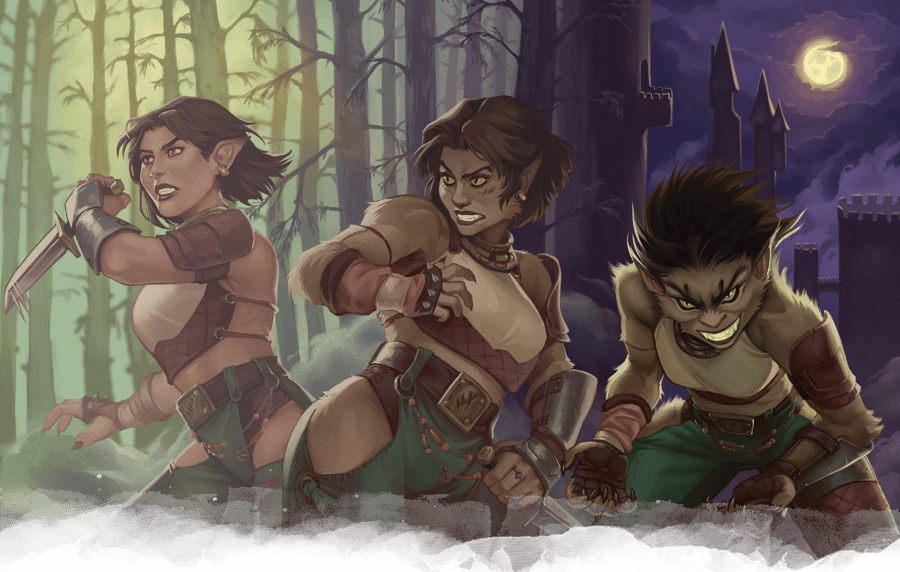
The Many Paths to Lycanthropy
Wondering how to start building your werewolf? There are multiple routes to explore, SO the best way to contract the curse is to choose the one that works best for your table.
Shifters
![5E24 EFA Shifter 1 Token[shifter,bestial,blue-hat]](https://pages.roll20.net/hs-fs/hubfs/5E24%20EFA%20Shifter%201%20Token%5Bshifter%2cbestial%2cblue-hat%5D.png?width=200&height=200&name=5E24%20EFA%20Shifter%201%20Token%5Bshifter%2cbestial%2cblue-hat%5D.png)
The most straightforward approach to playing a werewolf is to play the dedicated werewolf species, the Shifter. Hailing originally from Keith Baker’s world of Eberron (and also found in Mordenkainen Presents: Monsters of the Multiverse), the Shifters are a humanoid species of “weretouched”, with an inherent ability to shift between were-forms. The name “weretouched” comes from the fact that Shifters are considered descendants of the original Lycanthropes. However, the Shifters descend from a long lineage, meaning they don’t quite take the traditional werewolf form of their Lycanthrope ancestors. Instead, they take “beastlike” forms that make them look more animalistic, such as elongated teeth or fur. However, Shifters are designed to fit in any setting, which means they’re very “reflavor” friendly. In other words, if you and your DM can agree on it, your Shifter can take a form that looks and behaves closer to the traditional werewolf.
Mechanically, Shifters play like most other species, but when they shift, they gain one of the following benefits:
- Beasthide. You gain 1d6 additional temporary hit points. While shifted, you have a +1 bonus to your Armor Class.
- Longtooth. When you shift, and as a bonus action on your other turns while shifted, you can use your elongated fangs to make an unarmed strike. If you hit with your fangs, you can deal piercing damage equal to 1d6 + your Strength modifier, instead of the bludgeoning damage normal for an unarmed strike.
- Swiftstride. While shifted, your walking speed increases by 10 feet. Additionally, you can move up to 10 feet as a reaction when a creature ends its turn within 5 feet of you. This reactive movement doesn’t provoke opportunity attacks.
- Wildhunt. While shifted, you have advantage on Wisdom checks, and no creature within 30 feet of you can make an attack roll with advantage against you unless you’re incapacitated.
For more details on Shifter society, culture and roleplay, check out Races of Eberron or Exploring Eberron for more on the setting as a whole.
Flavored Subclasses
A slightly more involved method of becoming a werewolf, is to instead focus on werewolf adjacent classes rather than species. There are countless ways to flavor classes to look and play more like werewolves so long as you and your DM are willing to get creative. But if you’re looking for a class that has the transformation mechanics built right in, there are two great classes to start with.
Blood Hunter - Order of the Lycan![EGtW 2.0 NPC Blood Hunter 1 Token[beard,stalker,fury]](https://pages.roll20.net/hs-fs/hubfs/EGtW%202.0%20NPC%20Blood%20Hunter%201%20Token%5Bbeard%2cstalker%2cfury%5D.png?width=200&height=200&name=EGtW%202.0%20NPC%20Blood%20Hunter%201%20Token%5Bbeard%2cstalker%2cfury%5D.png)
The Blood Hunter, an original class created by Critical Role’s Matt Mercer, is a dedicated werewolf class and the clear choice for players who want the werewolf curse tied in directly with their class progression. At third level, the Blood Hunter chooses their subclass, and if you go with Order of the Lycan, you unlock the ability to transform into a hybrid beast-form for a full hour. While in this form, you gain the following features:
- Feral Might. You have advantage on Strength checks and Strength saving throws, and you have a +1 bonus to melee damage rolls. This bonus increases to +2 at 11th level and to +3 at 18th level.
- Resilient Hide. You have resistance to bludgeoning, piercing, and slashing damage from nonmagical attacks not made with silvered weapons. Additionally, while you are not wearing heavy armor, you have a +1 bonus to AC.
- Predatory Strikes. You can apply your Crimson Rite feature to your unarmed strikes, which you treat as one weapon. You can use Dexterity instead of Strength for the attack and damage rolls of your unarmed strikes, which deal 1d6 bludgeoning or slashing damage (your choice). This damage increases to 1d8 at 11th level.
- Additionally, when you use the Attack action to make an unarmed strike, you can make one additional unarmed strike as a bonus action.
- Bloodlust. If you start your turn with fewer hit points than half your hit point maximum, you must succeed on a DC 8 Wisdom saving throw or move directly toward the nearest creature and use the Attack action against that creature. If you’re concentrating on a spell or are under an effect that prevents you from concentrating (such as the barbarian’s Rage feature), you automatically fail this saving throw.
- If you have your Extra Attack feature, you can choose whether to use it for this frenzied attack. If more than one creature is equally near to you, roll randomly to determine your target. Once your attack is resolved, you regain control of yourself.
Beast Barbarian.png?width=200&height=200&name=max%20(70).png)
The Path of the Beast Barbarian is not strictly werewolf coded, but one of its predefined origins states that “One of your parents is a lycanthrope and you’ve inherited the curse”. This little piece of text provides the perfect staging ground to flavor the following 3rd level features as werewolf abilities.
-
Bite. Your mouth transforms into a bestial muzzle or great mandibles (your choice). It deals 1d8 piercing damage on a hit. Once on each of your turns when you damage a creature with this bite, you regain a number of hit points equal to your proficiency bonus, provided you have less than half your hit points when you hit.
-
Claws. Each of your hands transforms into a claw, which you can use as a weapon if it’s empty. It deals 1d6 slashing damage on a hit. Once on each of your turns when you attack with a claw using the Attack action, you can make one additional claw attack as part of the same action.
-
Tail. You grow a lashing, spiny tail, which deals 1d8 piercing damage on a hit and has the reach property. If a creature you can see within 10 feet of you hits you with an attack roll, you can use your reaction to swipe your tail and roll a d8, applying a bonus to your AC equal to the number rolled, potentially causing the attack to miss you.
The above two classes are specifically built to factor in werewolf transformations, but in D&D, any class can be flavored however you like. Anything as wacky as flavoring an artificer’s suit of armor as a werewolf form, to flavoring an echo knight’s shadow as a werewolf spirit is possible so long as you carefully coordinate with your DM.
Grim Hollow Transformations
The Grim Hollow setting introduces a transformation mechanic that includes the werewolf. Transformations are a great way to alter your character build with a relatively rules-light adjustment, making it easy to build a truly unique character that isn’t overshadowed by their lycanthropy.
Full NPC Surrender.png?width=200&height=200&name=max%20(71).png)
The last option is certainly the most hardcore. Here we can return to the Werewolf stat block from the Monster Manual, but do so knowing that you are no longer building your character. You are introducing a monster into the equation.
If you choose this path, think of the werewolf less as a transformation of your character, but a literal roll of the dice that puts an uncontrollable beast in the hands of your DM. When your transformation is triggered, this path will have you hand over the reigns to your DM, who will enjoy the full Werewolf stat block on behalf of your character, but will not take any interest in pursuing your goals.
This is arguably, the most true-to-form werewolf, but it does require a high level of trust around the table, because your transformations will certainly work against the parties interest.
Roleplaying a Werewolf
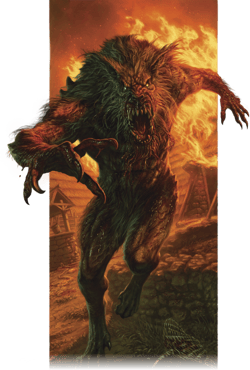
Few roleplay paths will require as much attention to “balance” as the path of the werewolf. To be afflicted with the curse of lycanthropy is to constantly live in the push and pull between your external self and your inner self. Do you fight the curse, or do you actively embrace it? Spend some time deciding exactly how the curse manifests in your day to day. Do you borrow certain animalistic traits, like an aversion to water and a love for the outdoors, or do you go the other direction, doing everything you can to seem as human (or elven/dwarven/etc.), as possible?
Most importantly, before you embrace the curse, have a chat with your DM.
Questions To Ask Your DM:
-
How will lycanthropy affect your character's alignment and goals?
Will lycanthropy have an affect on your character over time? Or, are you and your werewolf self aligned on morality?
-
If your werewolf form is controllable, how often can you transform?
Some more official paths like the Shifter or the Blood Hunter will state clearly how many transformations you have before a long rest (usually tied to your proficiency bonus). Still, if you’re homebrewing, this will be an important limitation to set early.
-
How does the world around you react to werewolves? Are they accepted like in Eberron, or are they feared and hunted?
Chances are your DM has this under control, but it’s good to know if you’ll be chased out of town before you decide to open up shop as a werewolf.
Curing Your Lycanthropy
Want out of the curse? Thankfully, many have gone before you, and the path to curing your lycanthropy is a well-traveled road.
If Bitten: Use the Remove Curse spell. It's a 3rd-level spell, but timing is everything. Cast it before lycanthropy takes full hold.
If Inherited: For those born with the curse, the Wish spell is your only option. It's a 9th-level spell and a major milestone in any campaign.
Embracing the Moonlight
Think you're ready to start howling at the moon? Lycanthrope life awaits, and it's only a few clicks away. Build your next werewolf character using Roll20’s character creator, and then explore the marketplace to find countless werewolf-appropriate campaigns, from adventures in Eberron to showdowns in the Shadowfell.
